fight the right
a creator campaign exploring how shared stories become narrative power
the activation
The campaign begins with a small group of influential creators.
Each receives a limited-edition pack of Fight the Right cards featuring examples of highly effective narrative content.
The cards are not campaign messaging but creative prompts.
Creators are invited to ask:
Which narratives are missing?
Which values need reinforcing?
Which archetypes are underrepresented?
How could this story be retold for my audience?
Each new piece of content is analysed, scored and transformed into another card.
Over time, the collection grows into a shared narrative library that other creators can browse, learn from and contribute to.
The campaign shifts attention away from producing isolated content and towards building collective narrative power.
the platform
As the collection expands, Fight the Right becomes a creator tool as much as a campaign.
Content can be explored by:
Narrative Archetype
Values Activated
Narrative Power
Narrative Completeness
Topic
Creator
AI-assisted analysis generates draft cards, while community discussion refines scores and strengthens consistency.
Instead of asking,
"What should I post next?"
Creators begin asking,
"Which narrative needs strengthening?"
The result is a growing library of speeches, podcasts, videos and campaigns organised by how they shape public understanding rather than by subject alone.
the impact
Fight the Right imagines a future where creators don't simply compete for attention—they collaborate to build culture.
Thousands of pieces of content.
Hundreds of creators.
One growing narrative ecosystem.
A shared language for discussing values, stories and political imagination.
Instead of measuring content performance alone, creators begin measuring their contribution to narrative infrastructure.
the legacy
Fight the Right began as an experiment in narrative literacy.
But it points towards something much larger.
A future where narrative analysis is as commonplace as analytics.
Where creators understand not only how many people they reached, but what worldview they helped reinforce.
Because political change is rarely created by a single speech, podcast or viral video.
It emerges when thousands of people repeatedly tell compatible stories about who we are, what we value and what kind of society is possible.
Fight the Right explores what might happen if we gave creators the tools to build those stories together.
the insight
Politics increasingly feels like a battle of narratives rather than a battle of policies.
Across social media, thousands of creators are producing thoughtful videos, podcasts, articles and explainers every day. Yet while these pieces of content often perform well individually, they rarely accumulate into a coherent cultural story.
Creators can measure views, likes and engagement. Campaigns can track impressions and reach.
But almost nobody can answer a much more important question:
What narrative are we reinforcing?
Research from narrative change practitioners suggests that political power is built not through isolated messages but through shared stories, values and moral worldviews that become embedded across culture over time.
The challenge is no longer producing more content - it is building narrative infrastructure.
the idea
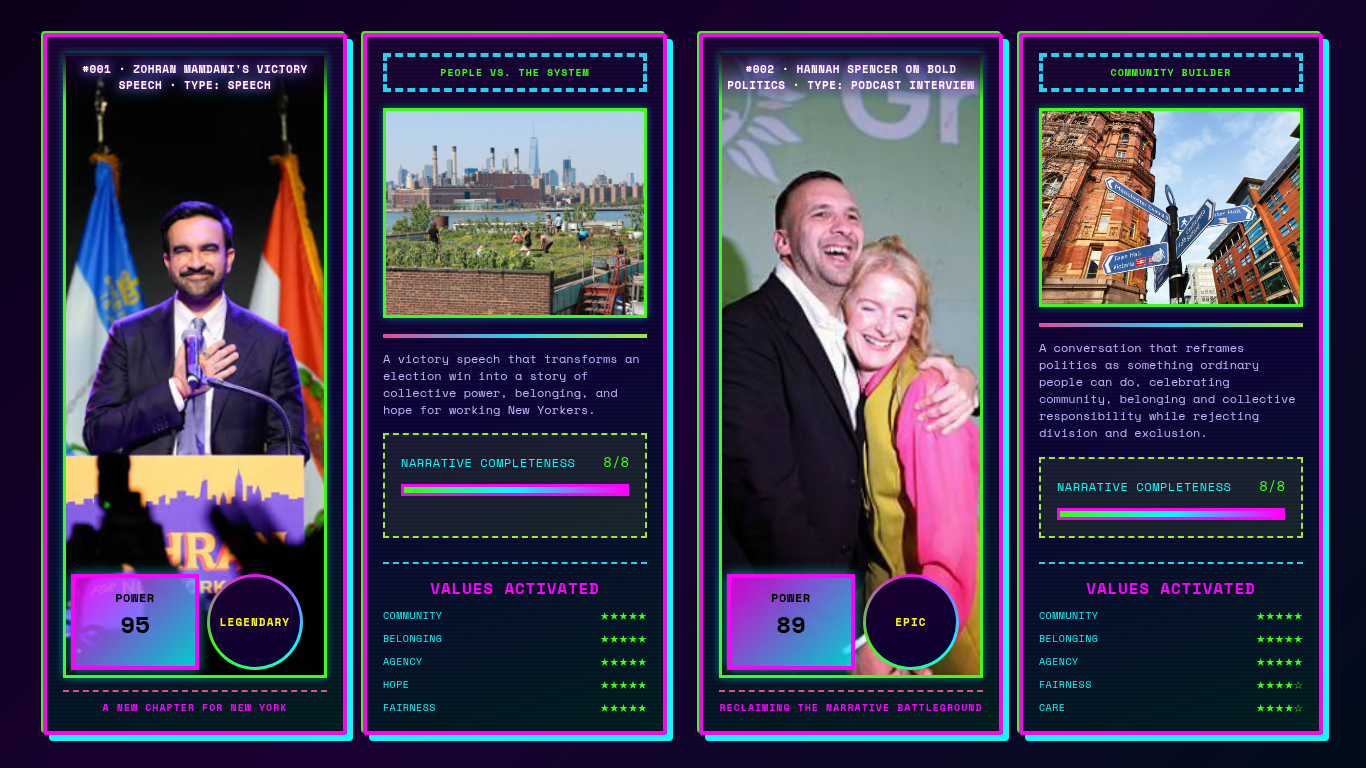
Fight the Right translates narrative theory into something creators can actually use, in the style of the classic British card game Top Trumps.
Using the FrameWorks model of narrative form, each piece of content is scored across eight narrative features:
Characters
Plot
Setting
Point of View
Evaluative Judgements
Intended Audience
Activated Social & Cultural Context
Relationship Between Features
Combined with Lakoff's work on values and recurring narrative archetypes, these become collectable cards that reveal:
Narrative Archetype
Narrative Completeness
Narrative Power
Values Activated
Rather than measuring popularity, the cards measure contribution to a larger story.
The aim is to help creators recognise not simply what they are saying, but the narrative ecosystem they are helping to build.