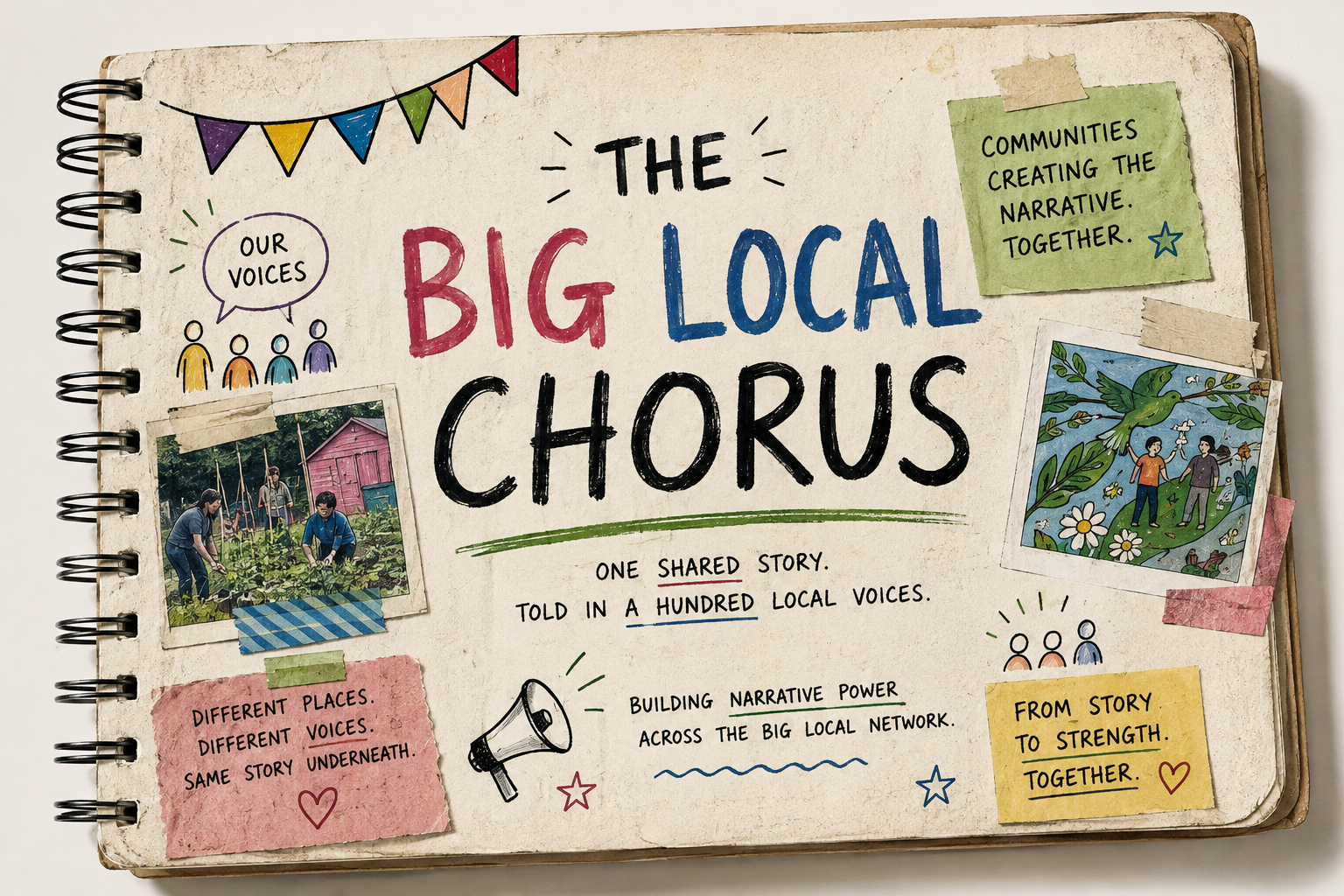
community chorus
one shared story, told in a hundred local voices
the idea
Big Local partnerships across England are brought together to name the dominant stories told about their communities — left behind, deprived, disengaged, dependent — and to identify the alternative story their own experience actually demonstrates.
Rather than receiving campaign messaging from the centre, partnerships co-create a shared narrative repertoire — a "chorus" — which every community is then free to perform in its own creative language: film, mural, spoken word, local press, a track, an exhibition, a community meal.
Rather than message consistency, something institutions so often want to control, the output is narrative consistency beneath creative diversity — many different stories that add up to the same worldview.
the insight
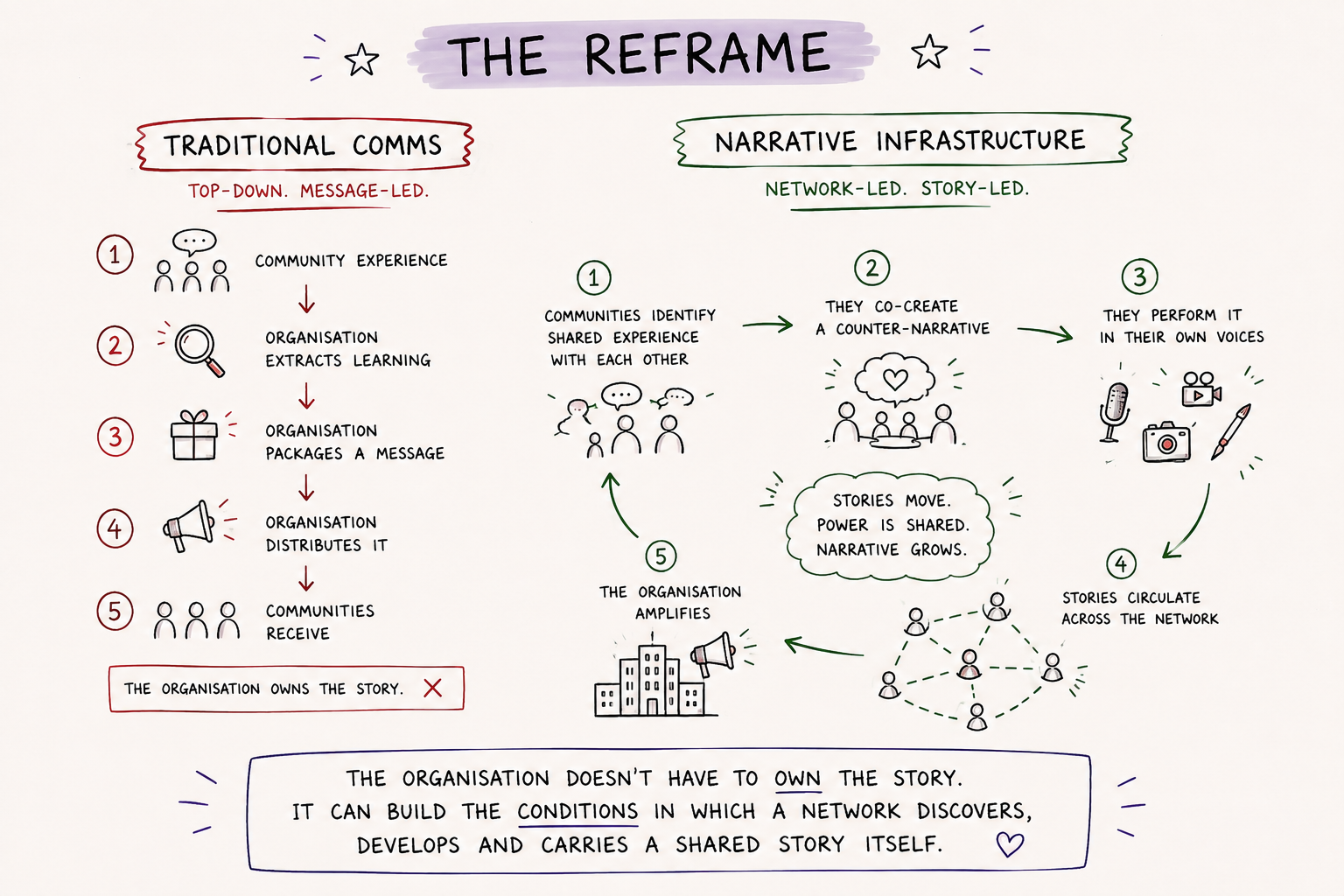
At Local Trust, part of my job was turning what I learned from Big Local communities into guides, case studies and content the organisation could send back out to the network. Revisiting that work recently, I wanted to interrogate why, if communities were the source of the knowledge, the institution was so often the one telling their story?
The case studies I created were true and positive examples of community change but they were still Local Trust's account of what a community had done. The organisation remained the narrator, and the community remained the subject.
Rather than a failure of a single campaign or piece of content, this example reflects a structural habit that runs through most funder communications: extract the learning, package the message, distribute it outward. In this dynamic, communities receive rather than author expertise.
The Big Local Chorus is a concept campaign that asks what changes if you flip that structure — if a funder's role in storytelling is to build the conditions for a network to find and carry its own narrative, rather than to write it on the network's behalf.
the chorus book
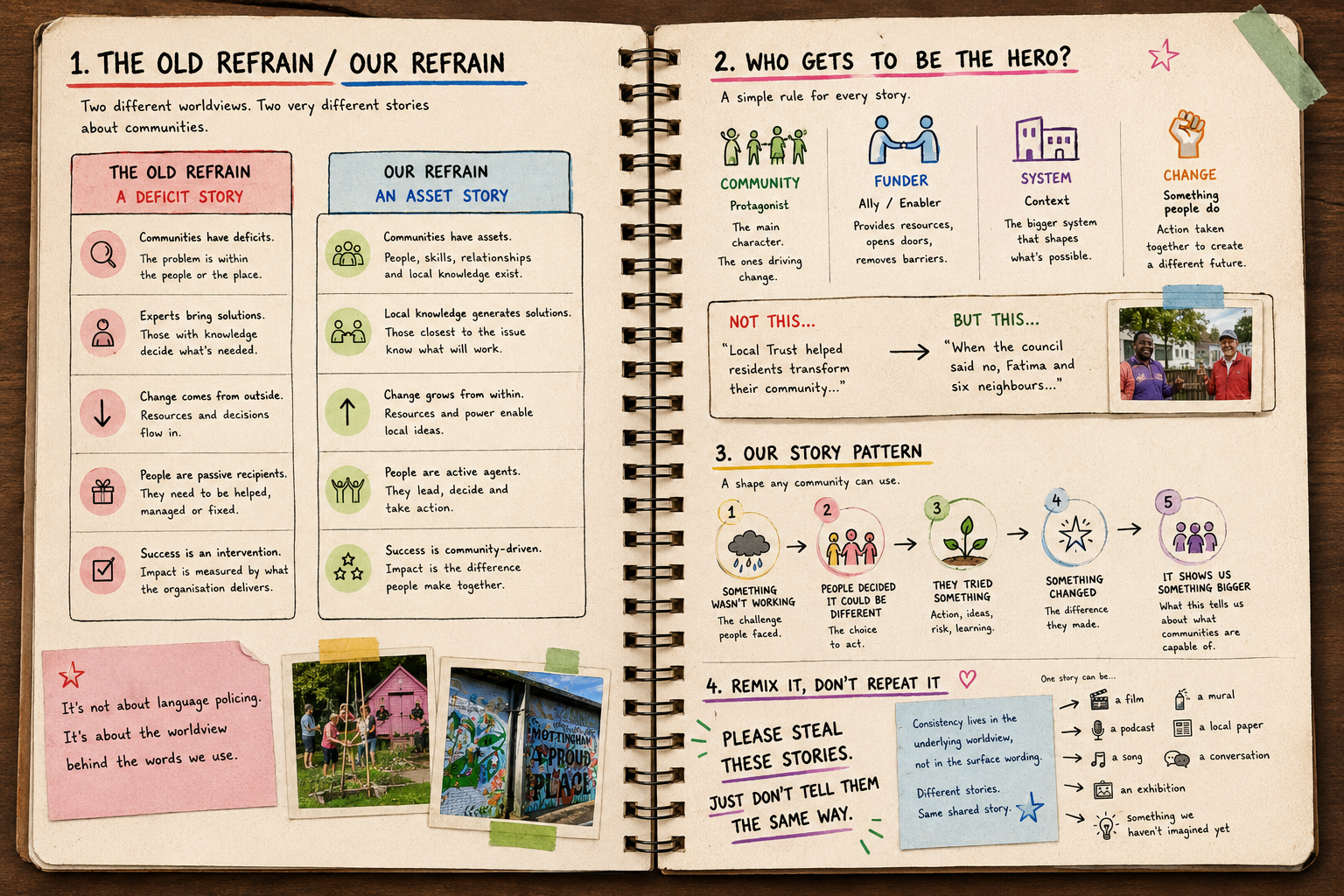
Instead of a messaging guide telling partnerships what to say, the chorus book is a shared repertoire helping them understand the story they're collectively building.
It opens with the old refrain set against our refrain — the dominant narrative that communities have deficits and experts bring solutions, alongside the counter-narrative that it's being replaced with: that communities have assets and local knowledge generates solutions. It isn't a list of banned words. It's an explanation of the worldview underneath them.
From there, a simple rule for every story: the community is the protagonist, the funder is an ally, the system is context, and change is something people do. "Local Trust helped residents transform…" becomes "When the council said no, Fatima and six neighbours…".
The book also gives every partnership a shared story pattern they can use to tell their own: something wasn't working, people decided it could be different, they tried something, something changed, and it shows us something bigger about what communities are capable of.
And it closes with the instruction that holds the whole thing together — remix it, don't repeat it. Please steal these stories, just don't tell them the same way. Consistency lives in the underlying worldview, not the surface wording.
I'd design the book itself to look handwritten and lived-in rather than corporate — annotated, photographed, argued with, added to. It should read as authored by a network, not issued by an organisation.
the activation
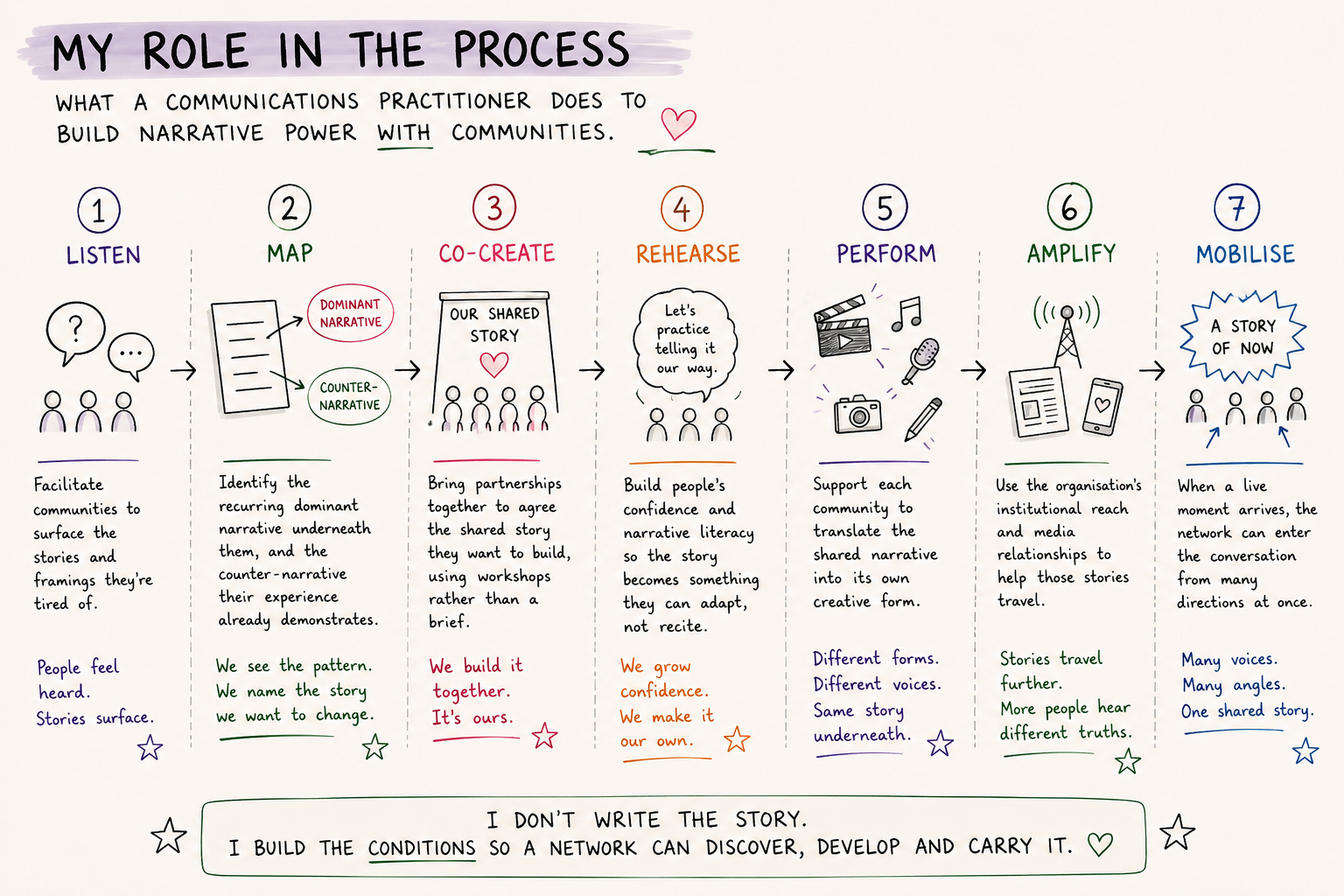
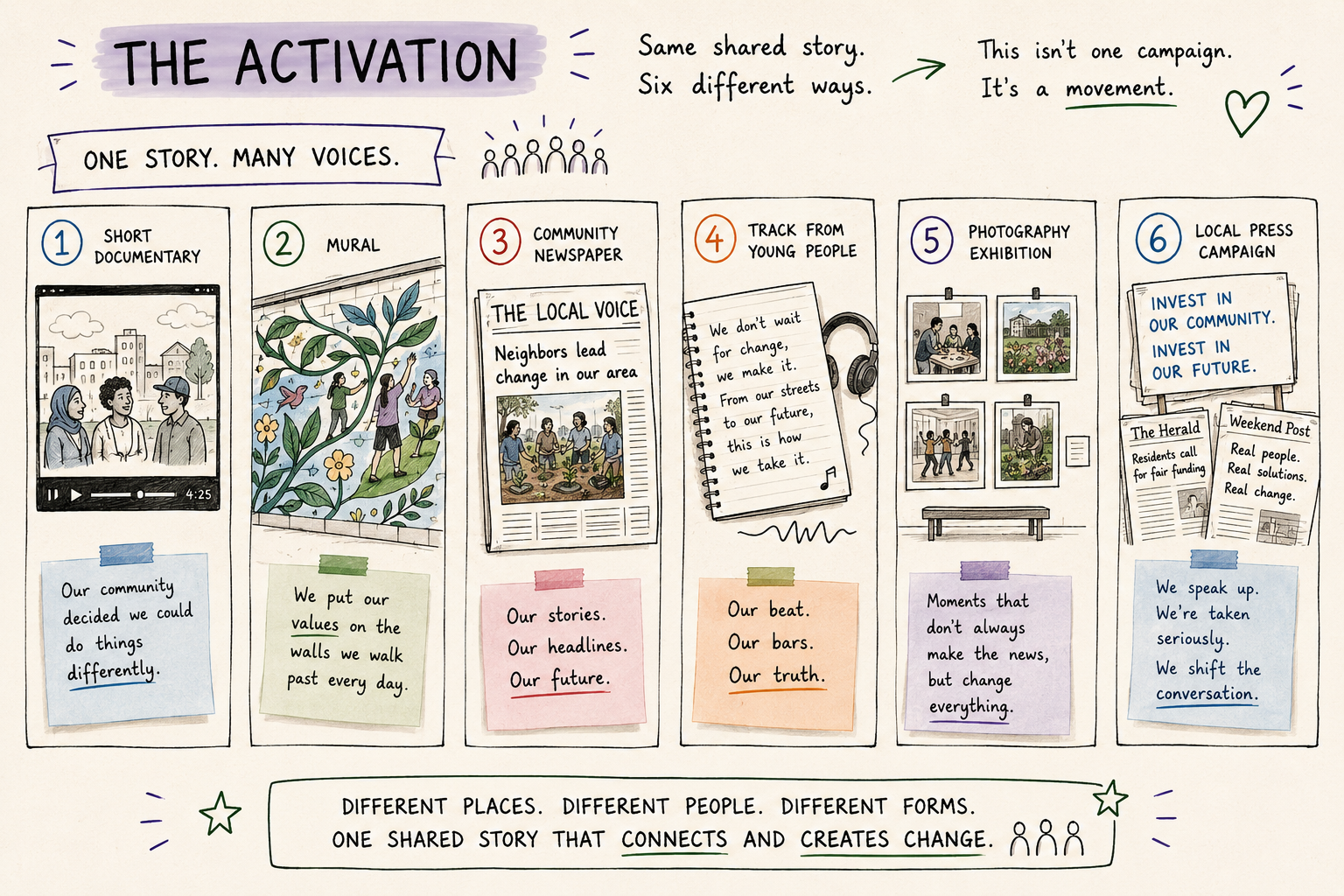
With help from the chorus book, a library of stories, relationships and creative work would sit in reserve. Then a "story of now" arrives — a politician calls a neighbourhood left behind, a regeneration scheme is announced, a high street closes. Because the network already has a shared counter-narrative, real storytellers and real evidence, several communities can respond at once, in their own voices, rather than the organisation scrambling to write a single statement.
The same shared story, performed six completely different ways: a short documentary from one partnership, a mural from another, a community newspaper, a track from a group of young people, a photography exhibition, a local press campaign. Placed side by side, they don't look like one campaign — they look like a movement that agrees on something.
the shift
Rather than claim this campaign would change the national conversation, I'd want to test something narrower:
Do participants who go through the workshops independently express compatible ideas, without being told to?
Do communities feel the shared narrative actually represents their experience?
Can partnerships identify and reframe a dominant narrative themselves, without facilitation, by the end of the process?
Does the counter-narrative show up across different channels and storytellers, not just the ones the organisation produced?
the legacy
This project started as a question about who gets to author a community's story. It ends as a different model for what a communications practitioner can contribute to social change: less author, more facilitator — building the relationships, shared values, and creative confidence that let communities shape the story told about them.
The goal isn't message consistency. It's narrative power.