Old work, new eyes: how a past campaign taught me to build narrative power
What revisiting my work through systems thinking and narrative change is teaching me about my role as a communications practitioner.
Duncan Green opens How Change Happens with Amartya Sen's idea of development as the expansion of people's freedoms to be and to do. It reminded me of bell hooks' writing on love, which draws on M. Scott Peck's definition of love as the will to nurture our own or another person's spiritual growth.
Two very different philosophies, but reading them together left me with a question I can't quite put down: maybe the job of anyone working towards social change is to get out of the way of the people closest to an issue, and to facilitate rather than prescribe.
I want to revisit my own work at Local Trust through that question.
the old approach
Local Trust delivered Big Local, a programme that put money and decision-making power directly into the hands of 150 communities across England. The whole philosophy ran against traditional top-down regeneration — communities knew their own places and were trusted to decide what change should look like there.
Looking back at some of my own communications work from that time, though, I can see a more conventional pattern underneath. We gathered community experiences, pulled out the lessons, and turned them into reports, guides, and campaigns for the institution. Find the insight, package it well, and get it in front of more people.
There's still value in that model. But Duncan Green's writing made me question where the expertise, and therefore the power, actually sits inside it. What would communications look like if they followed the same community-led principles as the programme they were communicating about?
the shift
One of Green's ideas that stuck with me most is positive deviance — instead of starting from what's missing and designing a solution to fill the gap, you look for people already achieving unusually good outcomes despite facing the same constraints as everyone else. The starting question shifts from “what solution can we create” to “who's already doing something interesting here, and how do we help that travel.”
Applied to communications, that's a real shift. My job doesn't have to be extracting knowledge from communities, translating it into an institutional voice, and redistributing it. It can be finding where useful knowledge already exists and using the institution's resources to give it more visibility, reach, and influence — moving from interpreting community knowledge to connecting, resourcing, and amplifying the people already creating change.
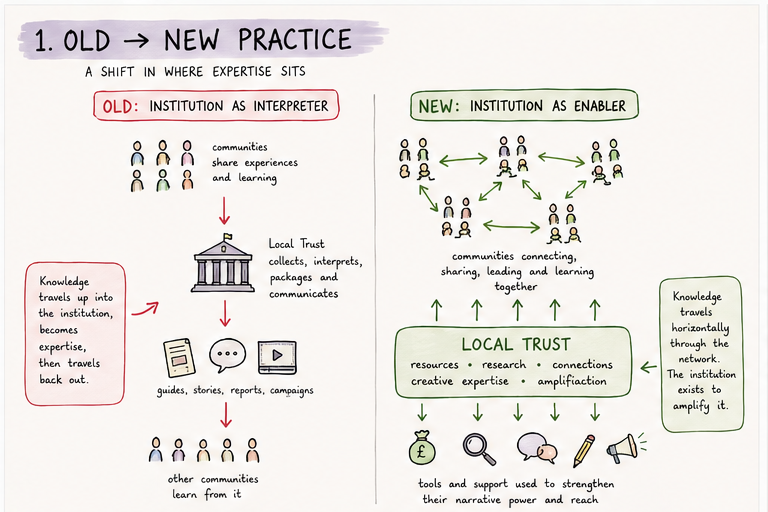
My emerging shift from seeing the institution as the interpreter of community knowledge towards seeing it as part of an ecosystem that can connect, resource and amplify the people already creating change.
the example
At Local Trust, I commissioned and edited community action plans, sharing learning from Big Local communities across the network. One, on youth engagement, drew heavily on Heston West, where young people and the local partnership had built their own approach to involving young people in the area.
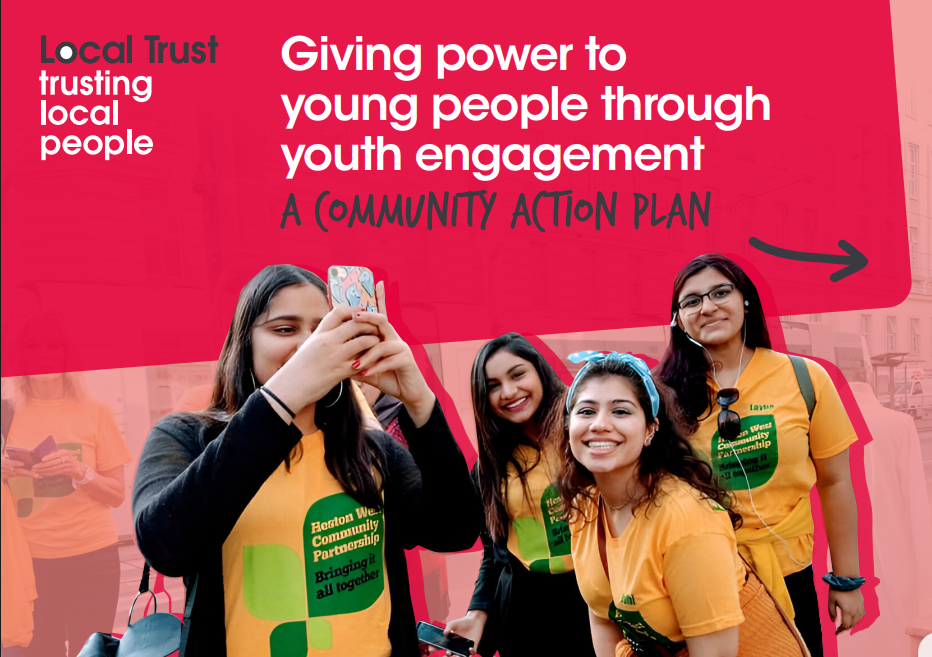
Community action plan: Giving power to young people through youth engagement, Local Trust, 2023.
Looking at it now, I notice who the piece positions as the expert. Local Trust is the most prominent name on it. The headline, “Giving power to young people through youth engagement,” describes a general topic rather than indicating that the people pictured have expertise worth learning from. Heston West is mentioned in the resource, but the framing suggests that Local Trust produced guidance on youth engagement, using Heston West as an example.
If I were approaching the same piece today, I'd reverse that relationship — position Heston West explicitly as the author and source of expertise, not the illustration.
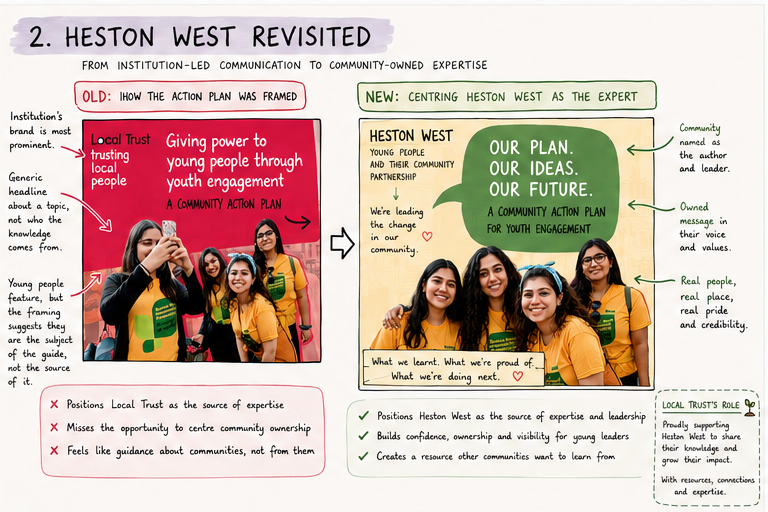
Reimagining the action plan with Heston West positioned as the source of expertise. The institution does not disappear; its power changes function.
The difference sounds cosmetic, but it isn't. Young people stop being subjects inside an institutional resource and become people whose knowledge others can learn from. Their names, place, successes and failures sit at the centre, rather than a polished set of recommendations sitting at the centre with them as evidence for it. Instead of moving straight to conclusions, you'd ask the questions that make a story genuinely useful to another community trying something similar: what did you try, what failed, what surprised you, what are you proud of, what would you tell someone starting this tomorrow?
Local Trust wouldn't disappear from the process. It would still bring funding, research, design, media relationships and reach. What changes is what those resources are for — helping Heston West's knowledge travel further, rather than becoming the frame it sits inside.
Community-led storytelling isn't just putting community faces on institutional content. It's reconsidering who owns the knowledge, who speaks, and whose authority the work ultimately builds.
the bigger picture
Reading more about narrative change also sharpened something for me: the difference between a story and a narrative. A story like Heston West's can humanise an issue and offer evidence that another way is possible. A narrative sits above that — it's the pattern of meaning through which people understand why things happen, who has agency, and what futures feel possible at all.
Local Trust could have gone further and worked with Big Local partnerships to ask what their very different experiences collectively demonstrated. Read individually, many of those experiences quietly challenge the assumption that expertise sits elsewhere, that institutions know what struggling communities need. Read together, they build a different case: that people living in communities hold knowledge, relationships and ideas that can create real change once they're trusted with resources and power.
A youth project in Heston West, a resident-owned building somewhere else, a local environmental campaign, an arts programme — none of these needs the same message. Their specificity is what makes them believable. But together they can reinforce something bigger: that communities aren't just places where interventions happen; they're agents of change in their own right. The real work is figuring out how hundreds of locally owned stories can reinforce that idea without sounding the same.
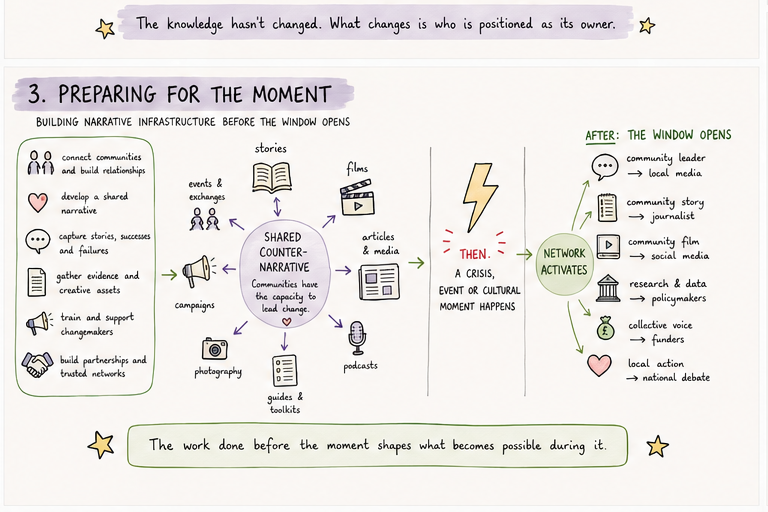
Building relationships, stories and a shared narrative before the window of opportunity appears allows a network to respond when the external environment becomes more receptive to change.
the infrastructure
Social systems are unpredictable. Political crises, economic shocks, and cultural moments can suddenly make a marginal idea feel urgent and relevant. You can't always predict when that window opens, but you can prepare for it.
Long-term narrative work is more than producing good individual content. It means building the relationships, stories, evidence, and shared frames that make an alternative way of seeing things visible again and again, in different places — what's often called narrative infrastructure. Across Big Local, that could have looked like helping communities who already knew each other, understood the wider story that their different experiences supported, and had relationships with journalists, policymakers and cultural organisations in place before they needed them.
Then, when loneliness became a national conversation, or a high street closure made the news, or an election raised questions about trust, or devolution entered the political agenda, Local Trust wouldn't need to start from scratch and ask what campaign to build. It could ask which communities already had something powerful to say about this moment, and how their stories could reinforce the counter-narrative the network had been building together all along.
The point was never to manufacture a message every time the news cycle shifted. It was to ensure that the relationships, ideas, and community-owned stories already existed before the moment arrived.
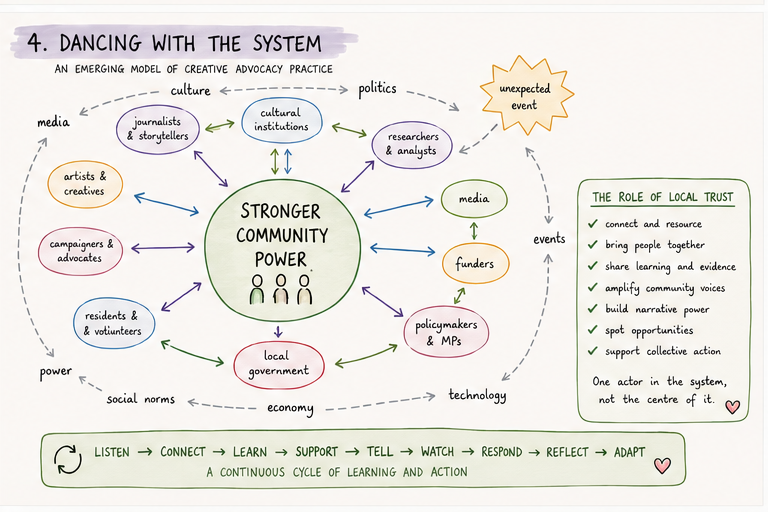
An emerging model of social change agents and my role as a creative practitioner within that.
the practice
Communications planning likes to think in a straight line: objective, audience, message, content, channel, evaluation. Green's idea of learning to dance with the system pulled me away from that. Communities experiment. Some things work; some don't. Political priorities shift, new voices gain influence, and once-marginal ideas can suddenly feel urgent.
Looking back at my work at Local Trust, I'd still use the same tools of the trade. I'd just use them differently — starting by identifying where change is already happening, treating communities as the owners of that expertise, connecting people so learning travels sideways rather than top-down, and building the relationships and creative resources that let those voices enter public conversation the moment the context shifts.
That's what dancing with the system means to me now: resisting the instinct to direct change from the centre, and learning instead to listen, connect, resource and adapt. I still want to find the brilliant story, commission the film, and spot the cultural moment. I just see those as tools of the practice now, not the practice itself. My role is becoming less about producing communications on behalf of people creating change and more about building the narrative power through which they can shape that story themselves.
I've since sketched out what that might look like in practice: The Big Local Chorus, a concept campaign for exactly this network.
