Narrative infrastructure: what if the problem isn't our messages, but the stories they belong to?
Why progressive political movements need to build narrative infrastructure, not more creative campaigns.
Spend enough time working on campaigns, and you become very good at making things.
A social post. A video. A report. A petition. A campaign launch. Then another social post explaining the campaign launch.
We have more ways to communicate than at any point in history. And politics has become an almost constant stream of content competing for our attention.
But I've been wondering whether we're measuring the wrong thing.
Because whilst a piece of content can reach a million people and disappear tomorrow, a story can stick around for generations.
The stories underneath politics
George Lakoff has spent much of his career arguing that political communication is not simply a competition over facts. It is a competition over frames.
Frames are the mental structures through which we make sense of the world. They help us decide what feels fair, who deserves what, what caused a problem and what kind of response feels reasonable. And beneath those frames sit values — fairness, freedom, security, responsibility, care, community, belonging.
This helps explain something that otherwise feels slightly strange about politics. Two people can encounter exactly the same fact and reach completely different conclusions — not because one of them doesn't understand the evidence, but because the fact has entered two different stories about how the world works.
This makes political communication much more complicated than finding the perfect statistic. Because every time we communicate, we are doing more than making an argument.
We are rehearsing a worldview.
Some movements got very good at this
For decades, conservative movements invested in more than election campaigns. They invested in think tanks, newspapers, commentators, academics and advocacy networks capable of repeating and adapting similar ideas across culture — about the market, the individual, tax, government, freedom, responsibility.
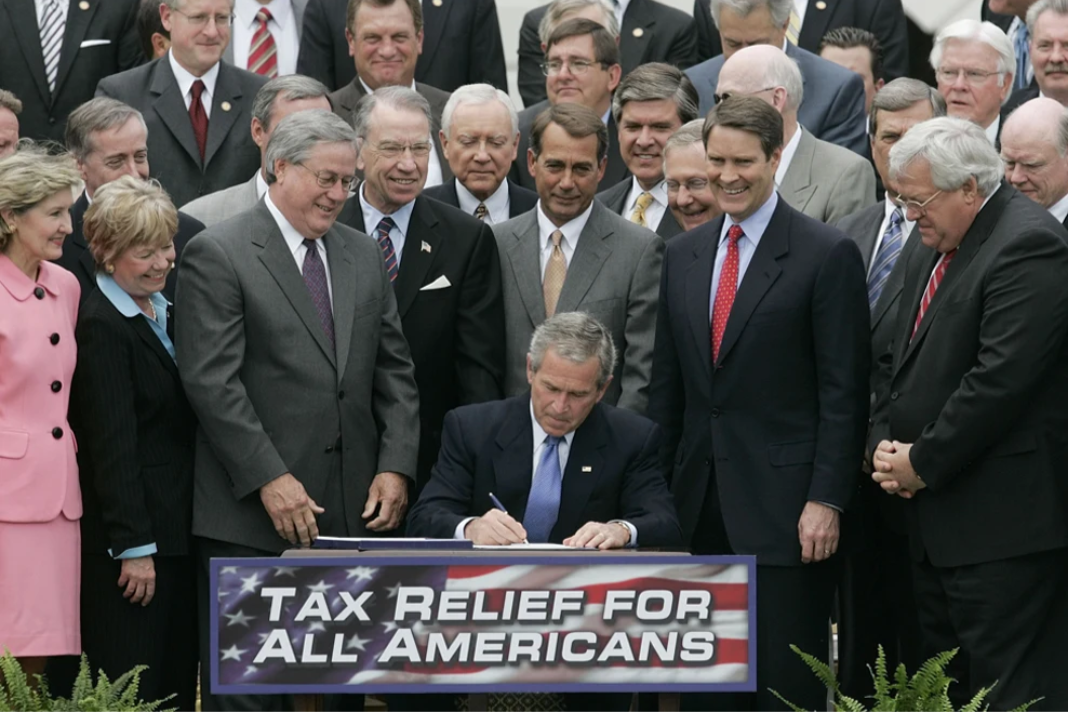
President Bush signs the $70 billion tax extension bill in a ceremony on the South Lawn of the White House, 2006. Pablo Martinez Monsivais / AP
The individual messages changed. The underlying story often didn't.
Over time, some of those ideas stopped sounding particularly ideological at all. They started sounding like common sense.
And perhaps that's what narrative power looks like at its most successful. Not when everyone remembers your campaign. When people forget there was ever another way of seeing the world.
Meanwhile, we make a lot of content
Progressive and social-change organisations are extraordinarily good at producing campaigns. Housing organisations talk about housing. Climate organisations talk about climate. Trade unions talk about work. Anti-poverty organisations talk about poverty.
Each campaign might contain excellent research, compelling arguments and brilliant creative work. But zoom out, and something strange can happen. The messages don't necessarily add up to a shared story. One organisation might frame housing as a human rights issue. Another as affordability. Another as supply. Another as inequality. Another as homelessness.
All may be true, but what larger story are they collectively teaching people about society? Perhaps it’s not that progressive movements need more content but stronger narrative infrastructure.
So what actually makes something a narrative?
This is where the work of the FrameWorks Institute becomes useful. Rather than treating narrative as another word for storytelling, its model breaks narratives into a set of interacting features: who gets to act and who is affected, what happened before and what might happen next, what kind of social or economic world the story takes place within, whose experience we're seeing it through, what it teaches us is fair or unfair, and who is being invited to recognise themselves in it.
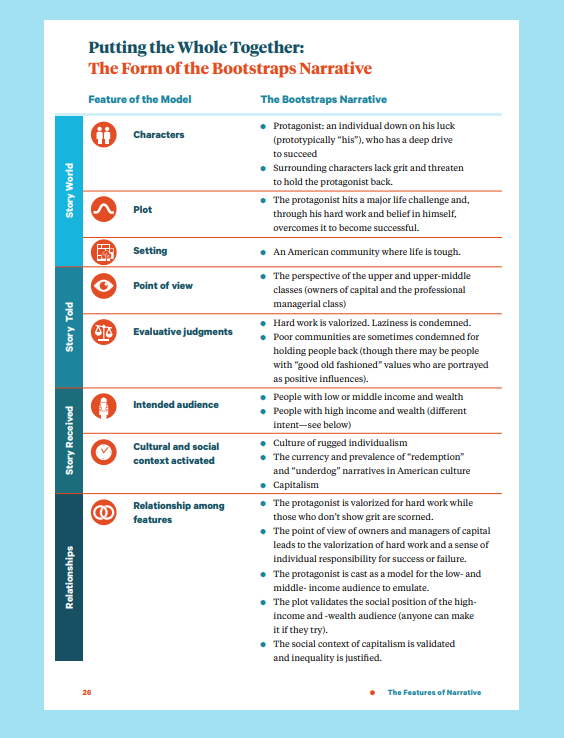
The Features of Narratives: A Model of Narrative Form for Social Change Efforts, by the FrameWorks Institute
But perhaps the most interesting part is their relationship. Because powerful narratives don't simply contain these ingredients—they reinforce each other. The characters fit the setting. The setting explains the conflict. The conflict activates values. Those values make the conclusion feel logical.
Suddenly, a forty-second TikTok isn't simply a forty-second TikTok. It is a tiny piece of architecture for understanding the world.
And then there are values
This is where Lakoff's work becomes particularly interesting. Political arguments often focus on policies. But people rarely experience politics as policy first. We experience it morally. Is this fair? Will my family be safe? Do people like me belong here? Are we responsible for one another?
A story about housing can activate a sense of fairness. A story about a neighbourhood can foster a sense of belonging. A story about organising can activate agency. A story about public services can activate care. And when thousands of different stories repeatedly activate similar values, something larger begins to form: a worldview.
Which means values aren't simply nice words to put at the end of a strategy document. They are the connective tissue between stories.
What if we could see all of this?
Creators already have incredibly sophisticated tools for understanding content — views, watch time, likes, shares, retention. We know exactly where somebody stopped watching a video.
But imagine opening your analytics and discovering something completely different: that your content strongly activates fairness, but rarely hope. That your movement has hundreds of stories explaining what's wrong, but almost none showing people creating something better.
Suddenly, analytics wouldn't simply tell us what got attention. They could help us understand the stories we're collectively building.
From content strategy to narrative strategy
Instead of asking what should we post this week?, we might ask what story needs another chapter? Instead of how do we get more engagement?, perhaps what worldview are we reinforcing?
Instead of thousands of creators unknowingly producing isolated pieces of political content, we could begin to see each piece as a contribution to something larger. Different voices. Different audiences. Different formats. But compatible stories.
Perhaps this is what narrative infrastructure looks like now
Historically, narrative infrastructure meant institutions — newspapers, think tanks, publishers, universities, political parties.
But the internet has changed who gets to tell stories at scale. A podcaster can reach millions of people. A TikTok creator can introduce a political idea to an audience that would never read a manifesto. A community organiser can document something happening on one street and have it seen across a country.
Narrative infrastructure no longer has to be entirely institutional. It can be distributed. Creators can be part of it. The challenge is helping people see the larger story they're contributing to.
I started sketching what a tool like that might actually look like — you can see where that thinking landed in Fight the Right →
